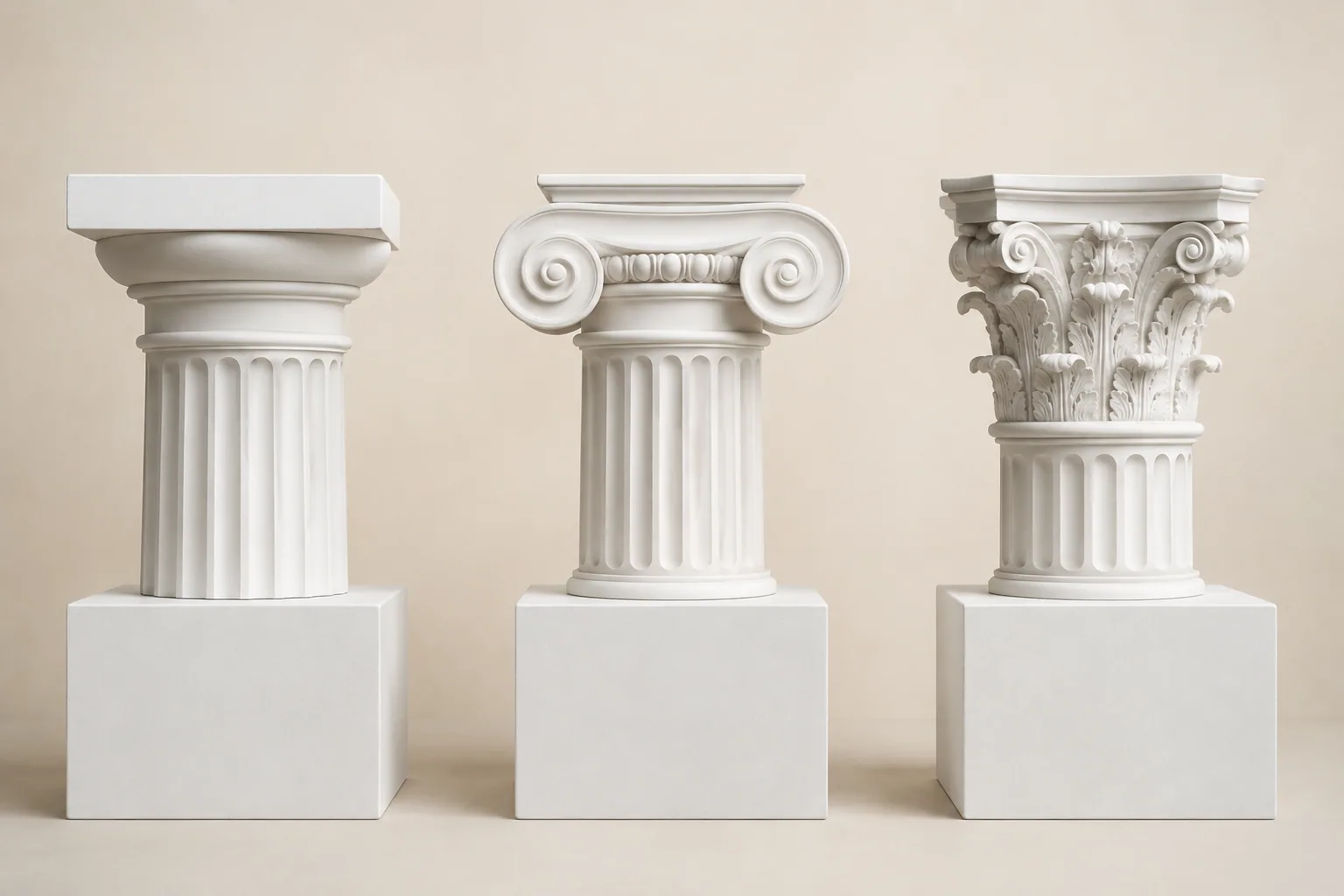
Doric, Ionic and Corinthian are coordinated architectural systems. The capital is often the fastest clue, yet a reliable reading checks the base, shaft and entablature as well.
Doric: structure made legible
In the Met’s account, the Greek Doric column is fluted and rises without a separate base. A cushion-like echinus supports a square abacus, while the frieze alternates triglyphs and metopes. The result can feel restrained, but “plain” is too vague to identify it.
The Temple of Apollo at Corinth offers a documented early Doric example. A simplified drawing helps a beginner isolate the profile, while a museum or site record supplies date, scale, material and condition. Both views are useful when their purposes are not confused.
Ionic: volutes within a system
Ionic columns stand on bases and use paired scroll-like volutes. The entablature is also distinctive: the architrave may be divided into horizontal bands and the frieze can run continuously. A frontal view makes two volutes obvious, while a corner capital must address two directions.
The visual cue should prompt a check rather than end the inquiry. Compare the shaft proportions, base mouldings and horizontal elements. Real buildings vary by period and place, and later architects reused Ionic language for new purposes.
Corinthian: a later, denser capital
The Met places the development of the Corinthian order in the late Classical period and notes its wider use in Hellenistic and Roman architecture. Its capital combines a bell-shaped core with acanthus leaves, spirals, palmettes and smaller corner volutes.
Dense foliage is memorable, but it is not a licence to call every leafy support Corinthian. The measured drawing of the Temple of Zeus at Euromos in the British Museum is a documented comparison point; a fantasy illustration is not.
Check the whole relationship
Ask four questions: does the column have a base, how is the shaft fluted, how does the capital turn at a corner, and what happens in the frieze above? The Met’s educational diagram places those components side by side so that the order reads as an assembly.
A nineteenth-century Greek Revival portico can use a classical order without becoming an ancient temple. Date, construction and function require their own evidence. Style helps organize looking; it should not erase historical context.
Reading takeaway
Use the capital to begin, then verify the relationships above and below it before naming an order.
Sources and scope
These references support the factual frame of this article. They do not endorse its contemporary illustrations or editorial interpretation.
- The Metropolitan Museum of ArtArchitecture in Ancient Greece
Temple plans, materials, painted decoration and the identifying relationships of the classical orders.
- The Metropolitan Museum of ArtGreek Art: From Prehistoric to Classical — Greek Orders of Architecture
Museum diagram and terminology for Doric, Ionic and Corinthian elements.
- British MuseumGreek Revival architecture: simplicity and splendour
Evidence for later reuse of Greek architectural language in a nineteenth-century museum.
- British MuseumTemple of Zeus at Euromos — measured drawing
Museum record for an eighteenth-century measured drawing documenting a Corinthian temple at Euromos.